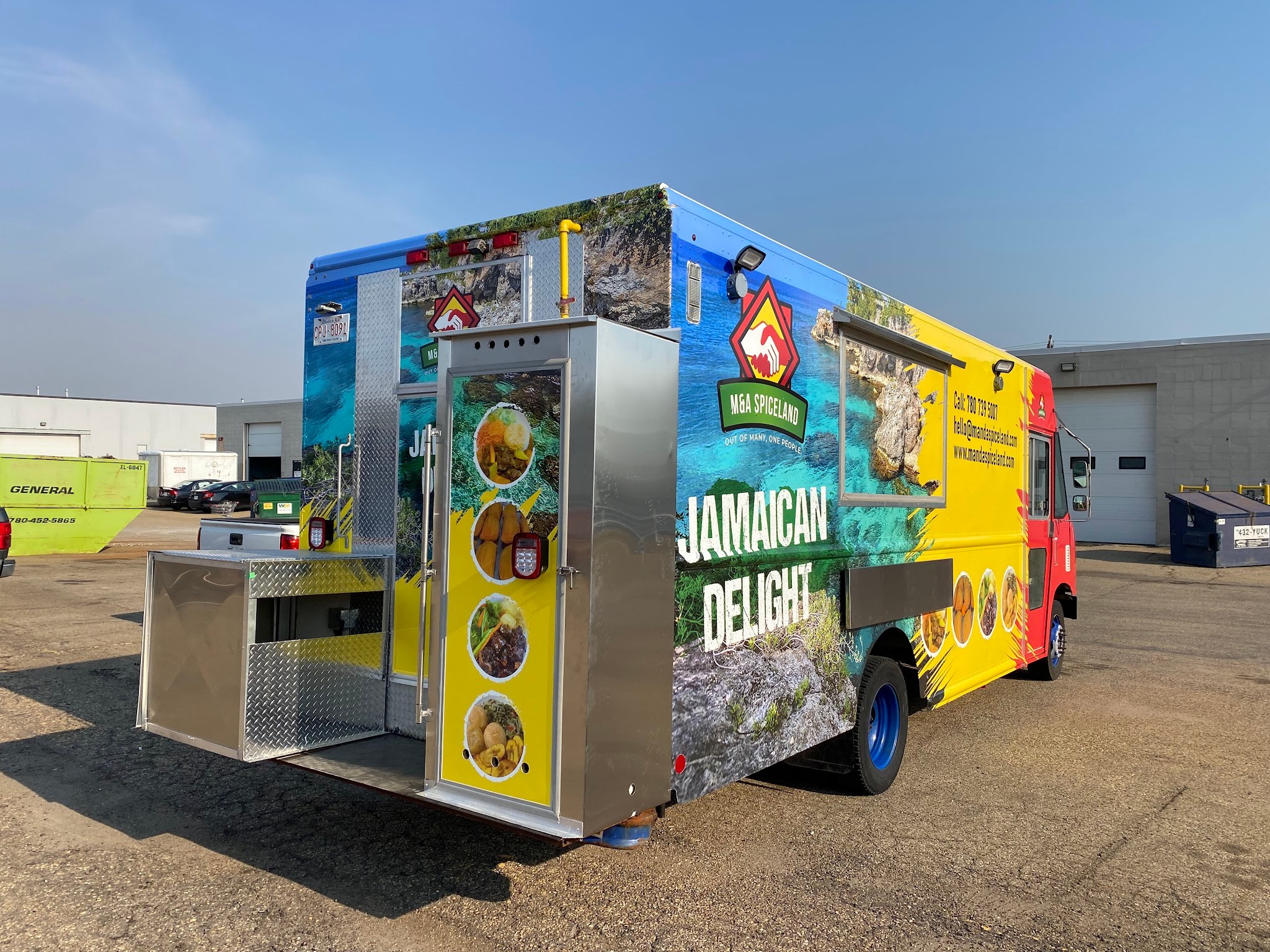
A food truck is not just a vehicle; it's a storefront on wheels, and the wrap is essentially the building signage for that storefront. The same surface needs to advertise the brand from 50 metres (so people walking by recognize it) and convey what's actually for sale from 5 metres (so people standing at the window can order). The wrap layout has to do both, and the install has to work around service windows, gas tanks, generator vents, and the equipment doors that food trucks are full of.
What's different about wrapping a food truck
- Service window cutouts. Most food trucks have one (sometimes two) large service windows on the curb side, and they're usually framed in metal that doesn't paint-match. The wrap stops cleanly at the service-window frame; the frame stays bare metal or gets a colour-match wrap as a separate add-on.
- Equipment vents and hatches. Propane gas storage doors, generator vents, water-tank fill ports, electrical disconnect panels: each one is an opening in the body that the wrap has to flow around without covering the access. We mask all of these on quote day.
- Compressor and exhaust components. Refrigeration condensers, oven exhaust vents, and the kitchen ventilation hood (typically rooftop) take heat and grease. Vinyl doesn't go on or near any of these.
- Curbside vs. street side. Most food trucks park curb-side, so the curbside (right side, with the service window) is the customer-facing side and gets the dense branding + menu info. The street side (left, where traffic passes) gets the visual brand identity for drive-by visibility.
- Wheel-well wraps for trailer-based trucks. Towable food trailers have larger wheel arches than self-driving food trucks; cast vinyl handles both but the trailer flares need more vinyl per arch.
Layout matters more than usual
A food truck wrap is half-graphic-design, half-restaurant-signage. The most successful layouts we've installed share these traits:
- Brand name is huge and legible at distance. Big enough to read from across a parking lot. Usually the upper third of the curbside panel.
- Menu signage is at eye height when customers approach. Lower third of the curbside, where someone standing at the window naturally looks. Often integrated with the service window frame.
- Photographic food images are saved for accent points, not used wall-to-wall. Photos at high resolution print well on vinyl; too many photos read as cluttered.
- Operating info (hours, social, location finder) lives near the service window. People asking those questions are already at the window.
- The non-service side is simpler. Brand, logo, one short tagline. Designed for highway-speed read.
Our design team can take these patterns and adapt them to your brand: most food-truck wraps include design as part of the project because the layout choices are too specific to do generically.
Pricing
| Work | Price |
|---|---|
| Cut-vinyl branding only (logo + name on both sides) | $1,200–$2,500 |
| Partial wrap, curbside service area + branding | $2,500–$4,000 |
| Full wrap, food truck or trailer | $3,500–$6,500 |
| Design fee (food-truck specific) | $600–$1,500 |
Full-wrap food trucks frequently exceed the standard ranges because of the curbside design density. We'll quote on site survey once we see your specific layout.
Related work
- Fleet wraps overview: multi-vehicle pricing and process
- Box trucks: many food trucks are built on box-truck chassis
- Cargo vans: smaller mobile-food operations
- Signs: if you also need fixed-location signage
Common questions
Will the wrap stand up to the heat and grease of food-truck operation?
Yes, the cast vinyl is rated well above the temperatures the exterior body sees, and we keep the wrap away from the kitchen exhaust hood and any direct heat source. Grease splash on the lower body is normal for food trucks; the vinyl wipes clean and is more grease-tolerant than paint.
What about food permit and safety requirements: do they affect the wrap?
Alberta Health Services food handling regulations don't restrict the exterior body. They do require visible operator info (business name, contact, permit number) which the wrap usually integrates. Site-specific event signage (festival permits, downtown vendor permits) sometimes requires additional displayed info: these go on as cut-vinyl additions or magnetic temporary panels.
Can you wrap a food trailer with the same approach?
Yes, towable food trailers wrap with the same materials and process. The trailer's hitch end and chassis edge get masked off as we'd do on any trailer wrap.
How long does the install take?
5–7 working days for a full wrap including the design phase. Without design (if you bring print-ready vector files), production is 3–5 days plus the install.